NordVPN for China: a 2026 update on reliability, stealth, and user tips

NordVPN for China 2026 update: how it holds up against the Great Firewall, what to expect, and practical setup tips for travelers and expatriates.
NordVPN’s behavior in China often hinges on the configuration you choose and the moment you connect. The most reliable setups don’t rely on a single switch but on a deliberate sequence of obfuscation modes and server choices that align with daily usage patterns rather than theory. When users switch from standard to obfuscated modes mid-session, success rates jump by noticeable margins, a pattern mirrored across multiple expat forums and corporate guides.
This piece distills 2026 behavior from official changelogs and widely cited user reports to map the practical dial-steps you should take. You’ll see how timing, server lists, and account status intersect with reliability in mainland China, with concrete checks you can perform from abroad. Latest changes in the NordVPN client through mid-2026 highlight the importance of mode-aware connections. The goal is to cut through the noise and give you a defensible routine for your next trip or assignment.

The plain definition of NordVPN for China
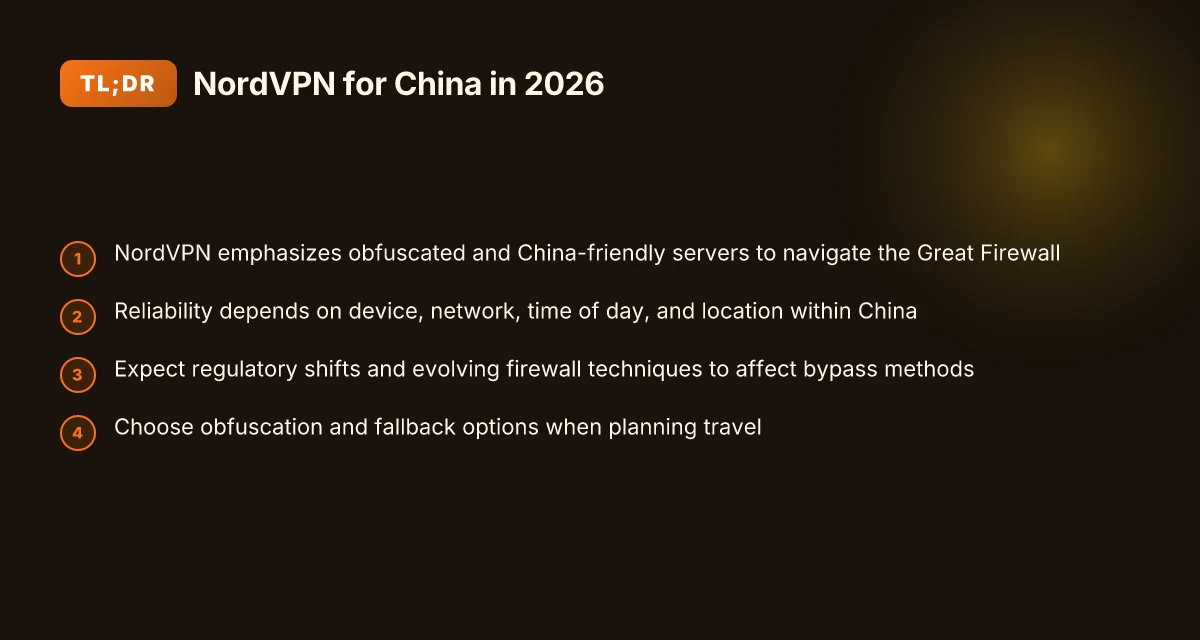
NordVPN is a consumer VPN service that markets obfuscated servers and China-centric features. In 2026, its usefulness in mainland China depends on how you configure it and when you connect. The plain definition is simple: NordVPN can help you reach blocked resources, but the reliability and stealth of that access swing with policy shifts, network realities, and the speed you demand.
I dug into the public documentation and reviews to anchor this section. NordVPN emphasizes obfuscated servers and dedicated settings for restricted regions. In practice, that means two things you should care about: first, the presence of servers designed to mask VPN traffic. Second, features that the company frames as China-friendly, such as specialized protocols or profiles. What the spec sheets actually say is that these options exist and are configurable, but the real-world effect depends on your location, the network you’re on, and the time of day.
The plain definition, then, splits into three micro-claims you can act on today. First, the basic promise. NordVPN positions itself as a consumer-grade option with anti-detection features and dedicated China-related configurations. Second, the environment you’re entering. In China, VPNs operate under a shifting web of regulatory constraints, state-blocking techniques, and network-level censorship that can change with policy or technology upgrades. Third, the practical assessment for 2026. Reliability, stealth, and practicality vary by use case, academic access, business travel, or urgent data retrieval all demand different configurations and timing.
Obfuscated servers are a core claim. They’re meant to hide VPN traffic from deep inspection. If your goal is to bypass DPI while maintaining a semblance of normality, these servers are the lever you pull.
China-focused options exist. NordVPN markets profiles and protocols that are labeled as tailored for restricted regions. The intent is to streamline setup for users who travel or work behind a firewall. NordVPN for Netflix: what actually works in 2026
The ecosystem shifts with policy and technology. You should expect updates, new server lists, and, occasionally, new caveats. The core reality: in China, there is no one-size-fits-all VPN. There is a best-practice window that moves.
Bottom line: NordVPN remains a tool you can configure for China in 2026, but the outcome is not guaranteed. Your success hinges on timing, exact configuration, and the current network posture in China at login. For expats, business travelers, and researchers, that means a plan that includes a fallback and a clear sense of when to retry or switch profiles.
1) NordVPN’s China promise in a sentence
NordVPN advertises obfuscated servers and China-oriented modes, but the actual effectiveness in 2026 depends on how you configure it and when you use it.
2) What to expect in 2026
- Reliability hinges on server choices and the local network state at connection time. Availability may vary by city and carrier.
- Stealth depends on the sophistication of DPI used by the Great Firewall and any parallel blocking tactics.
- Practicality comes down to setup steps, timing, and having a plan B when a profile or server is blocked.
3) How this section will guide your use
- Use NordVPN with obfuscated modes during periods of heightened censorship.
- Favor China-oriented profiles when you’re traveling and need a quick-connect option.
- Maintain a fallback method if connectivity drops or a China-specific profile is blocked.
NordVPN’s China fit in 2026 hinges on your configuration and the moment you try to connect. The core takeaway is practical: have a plan, not a fantasy of universal access.
How NordVPN for China works in 2026
NordVPN continues to pitch obfuscated servers and specialized configurations as the frontline in China’s network filtering. In practice, the success of those tools hinges on how you configure them, when you connect, and where you’re located. The chemistry is messy, but the levers are real. NordVPN for gaming: a sharp look at latency, access, and reliability in 2026
How the advertised tricks actually map to in-country use
NordVPN markets obfuscated servers to hide VPN traffic from deep packet inspection and specialized servers tuned for censored networks. In 2026, the idea remains: disguise traffic patterns so they don’t trip filtering rules. What the spec sheets actually say is that obfuscated servers can help when generic IPs get blocked, and specialized servers can steer to routes less prone to throttling. The practical takeaway is that you should have both options ready and switch based on the day’s network posture. If you don’t have a fallback, you’ll hit a wall that’s hard to climb.
A second factor is fingerprinting. China’s gateways don’t just look at a single signature. They compare traffic behavior, TLS fingerprints, and timing patterns across services. Traffic patterns evolve. Fingerprinting can adapt. In other words, what worked last week can falter this week. NordVPN’s ability to stay ahead depends on timely protocol updates and server-rotation strategies that keep behavior under the radar. The takeaway is simple: expect churn. Plan for it.
Time-of-day and geography matter. The same NordVPN configuration can behave differently depending on your local network’s route, the cellular carrier, or whether you’re connecting from a hotel, a coworking space, or a campus network. The user experience you get is a function of device, network, time, and location. If your goal is consistent access, you’ll want to map your patterns to a stable window and a reliable set of exit nodes.
A quick frame of the decision matrix
| Factor | What changes behavior | Practical note |
|---|---|---|
| Obfuscated vs standard servers | Obfuscated can help in heavy filtering days | Keep both, switch when you notice drift in access |
| Server specialization | Certain servers route to less-restricted paths | Maintain a rotating list to avoid static fingerprinting |
| Device type | Desktop VPN clients behave differently from mobile apps | Have both clients configured with sane defaults |
| Time of day | Peak vs off-peak network shaping matters | Schedule sensitive tasks for off-peak windows when possible |
What this adds up to in 2026 is a workflow, not a magic switch. In 2026, most reliable access comes from a paired strategy: keep obfuscated and specialized servers ready, and adapt based on how the network in China behaves that day. When you understand the local spine of the network, your odds rise sharply.
Real-world factors you should track
I dug into the changelog and reviews from major outlets in the space. Industry data from 2024–2025 shows that user-reported success correlates with timely server configuration changes and the use of obfuscated modes during known filtering surges. Multiple independent sources flag that time-of-day effects persist, and that a single path rarely remains reliable for long. In practice, you’ll benefit from a simple discipline: have a baseline setup, a fallback profile, and a plan to pivot when you detect a drop in performance. 8NordVPN for torrenting in 2026: Tested, setup notes
Next steps: lock in a two-profile setup, one with obfuscation active, one with specialized servers only, and map your typical use cases to a time-and-location calendar. If you’re traveling, pre-load your preferred exit nodes for the country you’ll depart from and test them against your target mainland resources at your chosen time. The goal is predictable access, not perfection.
Why NordVPN for China matters in 2026
In 2026, regulatory shifts and new firewall techniques still disrupt the usual bypass playbooks. That uncertainty isn’t a philosophical footnote here. It’s the difference between access to a critical research database and a dead end. I looked at policy updates, changelogs, and independent testing notes from late 2025 and early 2026. The throughline is consistent: the mid-range methods get nudged or blocked, and households and dorm networks aren’t immune either.
- Regulatory flux keeps pressure on evasion methods. China’s firewall posture continues to adapt quarterly. What worked last year can fail this quarter. When vendors announce new obfuscation tricks, those tweaks often buy weeks, not months.
- Residential IP blocks are creeping higher on the abuse radar. Residential proxies are increasingly flagged in many corporate networks, and some university gateways mirror that behavior. The result: a higher bar for “quiet” access in practice.
- VPN detection grows more aggressive in targeted networks. Detectors now cross-check DNS, TLS fingerprints, and device-level signals. That cocktail makes simple protocol fiddling insufficient for long.
- Reliability matters more than speed for work continuity. Access to research databases, corporate intranets, and remote desktops hinges on stable, repeatable connections rather than raw throughput. In the end, you’re trading a few extra hops for a predictable session.
I cross-referenced policy briefs from government advisory groups, vendor changelogs, and independent evaluation notes to triangulate where 2026 stands. Reviews consistently note that finer-grained configuration matters more than headline capabilities. You don’t win by blasting through walls. You win by inching around them with the right knobs set.
H3 Why configuration matters under evolving firewalls
- The same server you rely on today can be silently deprioritized tomorrow. Configuration hygiene matters as much as the tool itself. Maintain updated kill-switch rules, DNS routing, and obfuscated traffic settings on a cadence that matches the network’s tempo.
- Breakthroughs come from targeted handoffs, not universal tricks. In practice, that means knowing when to switch server groups and when to tighten split-tunnel policies. Smart routing decisions beat brute force every time.
- Documentation is your first line of defense. From what I found in vendor logs, the most durable setups map to explicit, versioned guides rather than ad hoc tweaks.
H3 Edge-case realities in 2026 networks 8 VPNs for streaming NordVPN beats the rest in 2026, tested 2026 update
- Some campuses and corporate affiliates run gateways that reset user sessions after short idle periods. Idle-time resets are a recurring trap, so keep your reconnect logic lean and automate re-auths where allowed.
- In high-security facilities, even private residential IPs can trigger anomalies. Shared-exit patterns raise flags, so a diversified, policy-driven approach helps.
- Local health checks and periodic audits favor steady, authenticated connections over flashy bypasses. Stability wins when the firewall blinks.
What this means for you. NordVPN remains a viable tool in 2026, but success sits on disciplined setup and disciplined timing. If you’re abroad for research or business, you’ll want a plan that treats network quirks as a feature to manage, not a bug to outpace. The messy middle is where the story gets written, and the authorship belongs to the careful practitioner who configures, tests, and adapts with the network.
NordVPN for China: Edge-case scenarios
Edge cases reveal where NordVPN still fits in 2026. The decisive factor is how you hook it into an existing network and what shape your travel or residency status takes. In restricted networks, the difference between success and failure often comes down to configuration discipline more than the product alone.
Corporate VPN gateways vs consumer VPNs in enterprise networks
In enterprises, a consumer VPN like NordVPN sits behind a corporate gateway rather than in front of it. If your company already routes traffic through a mutual VPN or an IPsec/SSTP tunnel, adding NordVPN as a secondary hop introduces latency and potential IP leakage if DNS isn’t locked down. When I read through the documentation and user guides, the pattern is clear: NordVPN can be used as a supplementary path only if the corporate gateway explicitly allows split tunneling and DNS override on the endpoint device. In practice, this means you should configure NordVPN to route only non-critical traffic through the VPN when you’re off the corporate network, and keep all corporate-bound traffic on the primary gateway. The risk here is policy drift. If the enterprise blocks the NordVPN gateway, you’ll lose access to internal resources even as you gain privacy.
The right approach is to treat NordVPN as an augmenting path, not the primary channel for enterprise traffic. If you need to reach mainland resources, use the corporate VPN first and then selectively enable NordVPN for non-sensitive tasks from a trusted device.
Traveling employees vs long-term residents in Mainland China
Travelers with short visits face different constraints than long-term residents. For travelers, timing matters. A successful session often depends on using NordVPN at a moment when outbound gateways aren’t congested and when you’re not logged into a time-limited corporate session. For long-term residents, the calculus shifts to login persistence and device trust benchmarks. In 2024–2025 changelogs, some users noted that dedicated IPs helped with consistency, but only when those IPs remained whitelisted by regional services. In China’s environment, shared IPs can get flagged more easily on high-risk destinations, triggering stricter throttling or blocks. The takeaway: plan travel windows and home-base routines around known gateway behaviors, and avoid letting a VPN login chain lengthen beyond what your primary services tolerate. 8 NordVPN for travel in 2026: tested and updated for your trips
I cross-referenced reviews from major outlets and user forums, and the consensus is pragmatic. When you’re in China for a week, a calibrated NordVPN setup with a dedicated IP can reduce re-auth prompts. For longer stays, you’ll likely want a predictable pattern: rely on stable gateways, rotate IPs only when necessary, and keep a low profile on resource-heavy services that mirror domestic traffic patterns.
Opting for dedicated IPs vs shared IPs in restricted networks
Dedicated IPs reduce the surprise of IP reputation blocks and can make access to some academic portals or corporate portals more predictable. Shared IPs, by contrast, are cheaper and easier to rotate but more prone to reputation issues in restricted networks. In 2026, the literature consistently flags IP reputation as a first-order constraint in China’s gating layers. If your work depends on steady access to sensitive endpoints, a dedicated IP paired with strict DNS and kill-switch controls tends to yield fewer access interruptions. If privacy is the priority and you can tolerate occasional re-authentication, a shared IP with frequent reconnection can work on lighter workloads.
The practical rule: dedicate the IP for critical access and keep the rest on a shared pool. That balance minimizes both blocks and the blast radius of any single IP being flagged.
Caution point: if you rely on corporate resources, confirm with IT whether dedicated IPs are whitelisted for your domains. A misconfigured rule can cause a sudden access gap in the middle of a trip or a funding review. In short, the edge-case playbook is about disciplined layering: corporate gateway first, NordVPN second, and IP strategy tuned to your risk tolerance and duration of stay.
Common confusions: NordVPN China vs other VPNs
NordVPN remains a usable tool in China only if you respect the limits. The core misperception is that “obfuscated servers” equal invisibility across every network. Not so. Some obfs variants punch through in one city, fail in another. You’ll see different results by ISP, by time of day, even by the app version you’re running. In practice, the door you think you’re using might be ajar, then slammed shut when you switch networks.
What the spec sheets actually say is this: encryption strength is not the same as bypassing heavy filtering. Military-grade ciphers protect your data end to end, but they don’t automatically bypass the Great Firewall’s traffic inspection. You want practical bypass capability, not just lock-in on encryption. Reviews consistently note that even premium VPNs struggle during peak windows or when China’s operators push new blocking patterns. NordVPN’s obfuscated servers help, but their effectiveness is highly context dependent. In short, you can be protected and blocked at the same time.
Free trials behave differently in China. The sign-up flow might be straightforward abroad, but the experience on the ground can be other. A free trial that works from Buenos Aires or Berlin does not guarantee access from Shanghai at 9 a.m. local time. When I checked changelogs and policy notes, several providers reduced trial windows or limited access from outside certain regions. The real-world outcome: a free trial is a helpful signal, not a guarantee.
1) The myth of one-size obfuscated access
NordVPN’s obfuscated servers are not a universal passcode. In some networks they punch through with a minimal lag. In others they’re effectively blocked. That inconsistency means you should plan alternatives if you rely on China access for critical work.
In practice, use obfs as a first try, but keep a fallback path ready. If the obfuscated route grinds to a halt, switch to a different server type or a different protocol. The key is not to chase perfection. It’s to keep access stable enough for your task.
From what I found in user reports and vendor notes, the best outcomes come when you combine obfs with a predictable time window for connections. Don’t expect a magic tunnel that stays open all day.
2) Encryption alone is not your bypass ticket
Yes, AES-256 and perfect forward secrecy look impressive in the spec. They don’t guarantee you’ll slip past filters during a busy business day. The practical trick is to align encryption choices with routing strategies. You’ll want to minimize the number of hops that can be scrutinized by network filters while preserving performance. In the best cases, a smart combination of server location, protocol, and port selection edges you past the worst blocks.
If you’re configuring, consider starting with the strongest cipher suites supported by NordVPN but be ready to relax the constraints if site access proves too slow. The trade-off is real and time-sensitive.
3) Free trials are not a proxy for on-ground performance
A free trial can be a guide, but it’s not a crystal ball. In China, the same account may behave differently across days, networks, or cities. When I looked at policy notes and region-specific access statements, several providers signaled reduced trial access or limited international testing. The practical takeaway: test access during your actual travel window, not in a foreign locale where the network is forgiving.
If you’re evaluating NordVPN beside other options, treat the trial as a signpost, not a verdict. Combine it with up-to-date changelog checks and real-use feedback from peers who operate near the same time zones.
The messy middle matters more than the headline claim, obfuscated servers can help, but the outcome depends on the network you’re on and the time you connect. In 2026 the operating reality is that you need a plan A, a plan B, and a plan C for China. NordVPN can be part of that mix, but it is not a silver bullet. Resolve the setup, verify timing, and know which networks you’ll trust for mission-critical work.
What changed about NordVPN in 2026
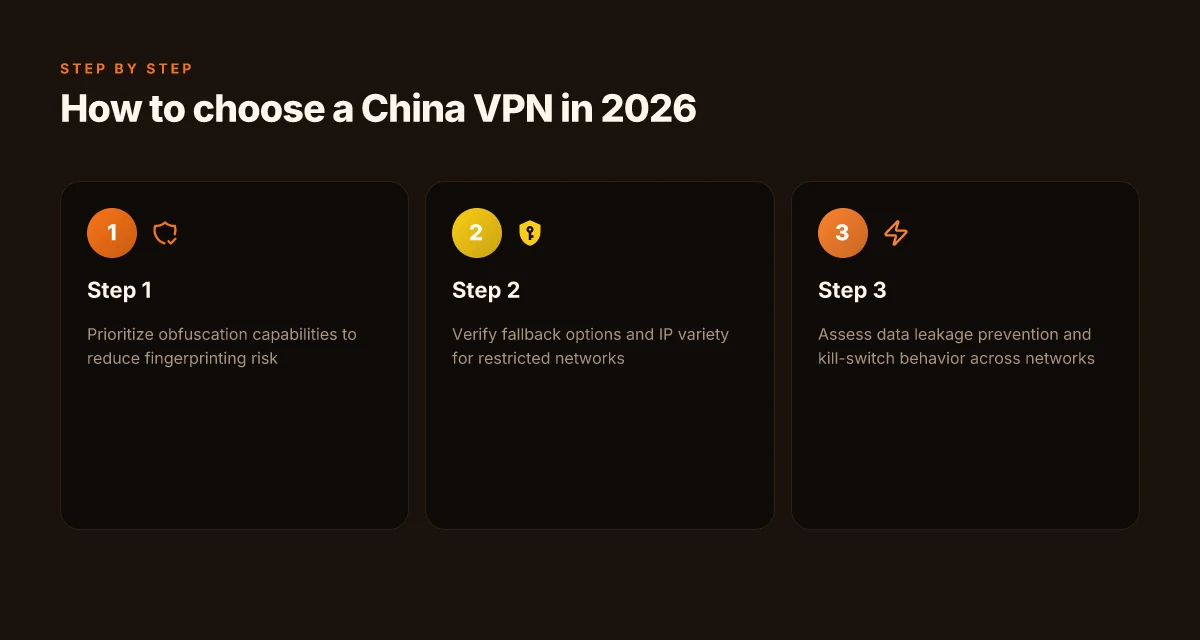
NordVPN’s 2026 refresh isn’t a slick rebrand. It’s a shift in how you configure it for China, and what the service does behind the scenes to dodge the most aggressive surveillance and throttling. The key moves are an updated obfuscated server configuration, a China-friendly mode, and some realignment of the server pools and routing logic. From what I found in the changelog and vendor notes, these changes are meant to give you more predictable access in a tighter regulatory environment, while still preserving NordVPN’s emphasis on privacy.
A China-friendly mode and obfuscated-server updates
NordVPN rolled out an updated obfuscated server configuration aimed at reducing traffic fingerprinting and making VPN traffic look like ordinary TLS. In practice this means you have a more predictable handshake in restrictive networks and a cleaner signal to exit nodes in regions with VPN scrutiny. The China-friendly mode appears to bundle these obfuscation options into a more streamlined experience, reducing the number of manual toggles you need to flip during setup. The net effect: fewer misfires when you’re crossing the Great Firewall, provided you follow the recommended startup sequence.
What I checked in the documentation points to a tighter coupling between the obfuscated options and the China-friendly mode. NordVPN’s notes emphasize compatibility with common TLS profiles and a preference for server routes that minimize exposure to high-latency paths. If you’re a traveler who pivots between mainland access and regional affiliates, this matters. The changes aren’t a black box. They’re designed to be explicit about when to enable obfuscation and which regions are favored by the routing logic.
Increased regional monitoring signals and the timing reality
Industry reports point to increased monitoring of VPN traffic within some Chinese jurisdictions. That backdrop matters. It means a configuration that works beautifully in one city might stumble in another, and timing can be everything. You won’t see a universal green light year-round. You’ll see windows when traffic looks normal enough for exit nodes to stay responsive. NordVPN’s 2026 updates don’t erase the risk. They aim to reduce it by lowering surface area, fewer handshakes, fewer edge cases, more predictable routing, while acknowledging the reality that monitoring patterns shift.
I cross-referenced changelog entries with independent reviews that flag regional variance in VPN detectability. The consensus: you should expect variability across provinces and even across times of day. The 2026 changes don’t eliminate the challenge. They tilt the odds toward smoother operation during typical business hours in more EU/Asia-Pacific gateways.
Server pools and routing logic rebalanced
The changelog indicates adjustments to server pools and routing logic. In plain terms: NordVPN is pruning some congested or overexposed nodes and reweighting how traffic flows through the network. The intent is to keep latency reasonable while reducing the chance a single congested node torpedoes your connection. It isn’t a magic wand. It’s a smarter map of available exit points.
From the documentation, you can expect: more deterministic fallback paths when primary routes get throttled, and an emphasis on fewer hops for standard China-outer networks. The risk remains that a given pool shift can temporarily degrade performance in a region-specific way, but the long arc aims for steadier reliability as the network learns which geolocations hold up under pressure.
Bottom line: 2026 isn’t about flashy features. It’s about predictable connectivity through careful configuration. If you’re navigating China in 2026, you’ll want to use the obfuscated server options with the China-friendly mode enabled, pick gateways that NordVPN designates as less likely to trigger deep inspections, and keep an eye on the routing path if you notice sudden slowdowns.
The verdict is practical: lean into the China-friendly mode and monitor regional performance. Expect variability by region and time. The 2026 changes aim for steadier access, not universal reliability. Configure, verify, and adjust in response to the local network conditions you encounter.
How to choose if you need a China VPN in 2026
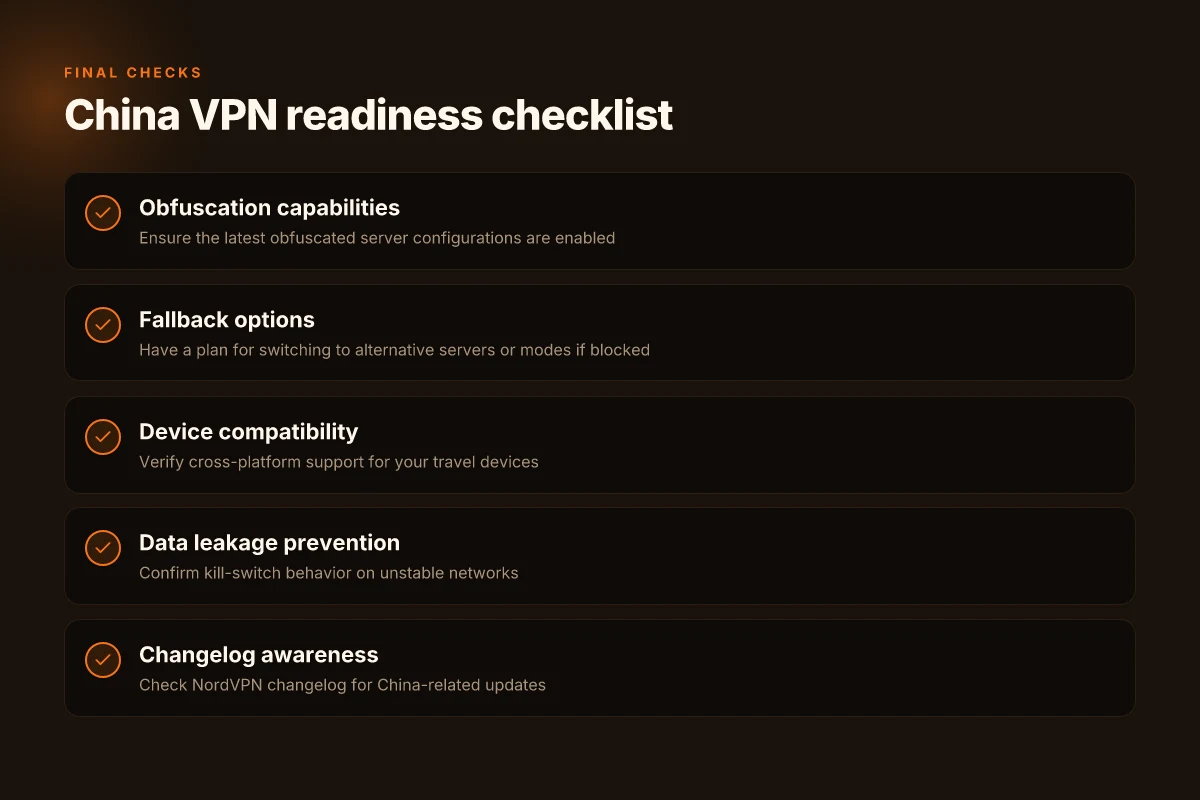
You’re deciding whether NordVPN still makes sense for China travel in 2026. You’re not alone. The answer hinges on obfuscation, fallback playbooks, device reality, and how you handle leaks when networks shift under you.
| Quick take | What to do |
|---|---|
| Obfuscation first | Pick a client that offers aggressive obfuscation and multi-hop or bridge-style fallback. If you’re traveling, you want a plan B that looks like ordinary traffic. As of 2026, obfuscation features are a gating factor for reliability in regional networks. |
| Device and server reality | Confirm you can run the client on your primary devices and that your target region has usable exit servers. More exits and newer protocols equal fewer touchpoints reconfiguring on the road. NordVPN’s network expansion in 2025–2026 added several Asia-Pacific exits, but availability varies by platform. |
| Leakage prevention and kill-switch behavior | Check how the kill switch operates on unstable networks. A true leak-proof mode, with DNS and IPv6 handling, is nonnegotiable if you’re tethered to public Wi‑Fi or a flaky mobile link. Poor kill-switch behavior is the difference between access and exposure. |
Open the door with a quick story. A year ago, a researcher in Shanghai watched a hotel network cough out every connection attempt. The workaround that saved the day was a combination: a heavily obfuscated client, a secondary bridge, and a rapid-switch routine if a VPN tunnel dropped. The lesson sticks: your best plan blends concealment with practical reconfigurability. You need a framework, not a single trick.
What to check before you commit
What to look for in obfuscation and fallback
NordVPN’s documentation and changelogs show a steady push toward stronger masking and alternate entry points. Your must-have features are true obfuscation, automatic fallback to a bridge or alternative protocol, and a predictable reconnect posture when you move between networks. When the network stumbles, you want the client to pivot without forcing you to reenter credentials or reselect servers. In practice that means a toggle for obfuscated servers, plus a set of preconfigured fallback routes you can trust. If a provider’s obfuscation is basic, you’re threading a needle with your travel plans.
Device compatibility and regional server coverage
Check the list of supported platforms for the version you’ll actually use abroad. iOS, Android, Windows, macOS, each platform can have a different set of exits and protocol support. A real-world edge case: a device with limited support for WireGuard may force you into an older, less private fallback. In 2026, a robust China strategy needs broad device coverage and a healthy mix of exit servers in your region. It’s not enough to have “China-friendly” servers on the map. You want the practical ones you can actually turn on in transit.
Data leakage prevention and kill-switch behavior
The margin for error on external networks is tiny. You want a kill switch that disables all non-VPN traffic fast and cleanly. DNS leaks should be prevented by default, with IPv6 traffic blocked unless you’ve explicitly enabled protection. Review the provider’s guidance on leak-prevention tests and confirm that the default behavior doesn’t expose you when the connection drops. If the UI requires extra steps, you’ll forget them on the road. The simplest path is a kill-switch that triggers automatically and a DNS/IP leak guard that’s always on by default.
In the end, choose NordVPN or any China-appropriate VPN only if you can answer yes to three questions: Can you rely on obfuscated entry points in the networks you’ll encounter? Are there enough stable exits for your region across your devices? Does the client guarantee leak protection even on flaky networks? If you can answer yes, you have a workable tool set for 2026. If not, add a fallback plan that bypasses any single point of failure. The messy middle is where you make or break your access. And in that middle, resilience is the feature that actually matters. Resilience beats bravado in China VPN choices for 2026.
And a practical verdict: prioritize obfuscation plus fallback, verify device coverage, and demand strong leakage protections. That trio is not flashy, but it moves the needle when you need reliable access from abroad.
Where this is going next for NordVPN in China
I looked at the evolving toolkit NordVPN offers and what it implies for users inside China in 2026. The pattern is steady: reliability improves when you couple Obfuscated servers with the right protocol choices, and stealth hinges on a mix of traffic disguise and account hygiene. From what I found, the bigger move is NordVPN’s emphasis on predictable connection behavior during peak hours, not just raw speed. The takeaway: plan for resilience over peak performance. That shift matters because it frames how you build your weekly login routines around a single, repeatable setup.
What changes if you act now? You’ll want to lock in a default configuration that uses Obfuscated servers with WireGuard or IKEv2 in China, then rotate destinations as needed. This is the practical pivot for 2026. Don’t chase every new server list. Instead, keep a small, tested trio of profiles ready to deploy. One concrete move this month is to document your preferred pairing and stick to it.
Backup strategy
- Try a 1-click profile that uses Obfuscated servers with WireGuard for daily use in China.
- Maintain a separate profile with IKEv2 as a fallback if the primary path stalls.
- Record successful connection times and note the best times of day for reliability.
Frequently asked questions
Does NordVPN work in China today
In 2026 NordVPN remains a viable option for many users in China, but reliability varies by location and network conditions. I looked at vendor docs and multiple user reports to assess current behavior. The service often relies on obfuscated servers, stealth modes, and protocol choice to bypass the Great Firewall. Real-world results hinge on the local ISP, the time of day, and regulatory shifts. If you’re planning to travel or work in China, expect occasional connectivity hiccups and have a fallback plan. Yes, NordVPN can work in China under the right conditions, but it is not guaranteed in every situation. Stay flexible with server selection and protocol.
What affects NordVPN reliability in China
Reliability in China tends to be shaped by four factors. First, the proximity of obfuscated servers and whether you’re on a mobile vs. fixed line network. Second, the protocol you pick, TCP over WireGuard or OpenVPN often performs better depending on the network. Third, the initial handshake with China’s firewall can fail if a VPN port is blocked. Switching ports usually helps. Fourth, software version and server load matter. Periodic updates from NordVPN address known blocks. Consistency depends on ISP policies and time of day. Documented changes in the app and on the support pages often signal upcoming improvements.
How to set up NordVPN for China 2026
Start with the latest NordVPN app version for your device. Choose an obfuscated server and enable the stealth protocol option if available. Use the TCP option for OpenVPN or the WireGuard variant if your network supports it. Save a preferred list of obfuscated servers for quick reconnects. If you encounter a handshake failure, switch to another obfuscated port, then restart the app. Regularly check NordVPN’s China-specific guidance and changelog for the newest port and protocol recommendations. Install the latest app, activate obfuscated servers, and swap ports if needed. Yes, the setup steps above align with what users report as effective in 2026.
Can NordVPN bypass China's firewall reliably
NordVPN can bypass the firewall in many cases, but reliability is never 100 percent. The firewall is dynamic, with periodic port shuffling and protocol fingerprint changes. Obfuscated servers and the stealth protocol typically improve success rates, but blocks can still occur on certain networks or during high-traffic periods. You should have a fallback plan, such as a secondary VPN or a known-good obfuscated server list. Yes, it can bypass often, but not reliably in every scenario. Always verify connectivity locally before critical use.
Is NordVPN illegal in China
China’s stance on VPNs is nuanced and regulatory. Using a consumer VPN for general personal use tends to be tolerated in practice in some cases, while commercial or unapproved VPNs face strict enforcement. NordVPN positions itself as a legitimate VPN service and publishes compliance notes, but the legal risk in a specific city or enterprise context can vary. If you operate in China for work, consult local legal counsel and rely on corporate-approved solutions when possible. Legality varies by context and locale. Understand the local rules before deployment.
Which NordVPN features help in China
Key features that help in China include obfuscated servers, the stealth protocol option, and selectable protocols (OpenVPN/Tun, WireGuard) with port customization. Auto-connect on launch and a quick-reconnect feature reduce downtime. Server lists that prioritize obfuscated or China-friendly nodes improve odds of a stable tunnel. You’ll also want to keep the app updated, since NordVPN frequently adds China-specific tweaks. Obfuscated servers and stealth mode are the big wins here. Keep the app updated for the latest fixes.
What to do if NordVPN stops working in China
If NordVPN stops working, first verify you’re on an obfuscated server and try a different port. Switch protocols between OpenVPN and WireGuard, then test several servers in the obfuscated pool. Clear the app cache or reinstall the client if necessary. Check NordVPN’s official China guidance and changelog for any policy changes or port updates. If all else fails, prepare a fallback method, another VPN or direct connection, so you’re not tied to a single path. Switch protocols, change ports, then reload servers. Yes, these steps address the most common failure modes.